Thursday, January 14, 2016

Syria: The story of the conflict

More than 250,000 Syrians have lost their lives in four-and-a-half years of armed conflict, which began with anti-government protests before escalating into a full-scale civil war. More than 11 million others have been forced from their homes as forces loyal to President Bashar al-Assad and those opposed to his rule battle each other - as well as jihadist militants from Islamic State. This is the story of the civil war so far, in eight short chapters.

1. Uprising turns violent

Syrian protestersImage copyrightGetty Images

Pro-democracy protests erupted in March 2011 in the southern city of Deraa after the arrest and torture of some teenagers who painted revolutionary slogans on a school wall. After security forces opened fire on demonstrators, killing several, more took to the streets.

The unrest triggered nationwide protests demanding President Assad's resignation. The government's use of force to crush the dissent merely hardened the protesters' resolve. By July 2011, hundreds of thousands were taking to the streets across the country.

Opposition supporters eventually began to take up arms, first to defend themselves and later to expel security forces from their local areas.

line break

2. Descent into civil war

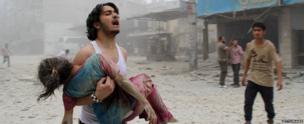
Grieving Syrian man and injured girlImage copyrightGetty Images

Violence escalated and the country descended into civil war as rebel brigades were formed to battle government forces for control of cities, towns and the countryside. Fighting reached the capital Damascus and second city of Aleppo in 2012.

By June 2013, the UN said 90,000 people had been killed in the conflict. However, by August 2014 that figure had more than doubled to 191,000 - and continued to climb to 250,000 by August 2015, according to activists and the UN. 

The conflict is now more than just a battle between those for or against President Assad. It has acquired sectarian overtones, pitching the country's Sunni majority against the president's Shia Alawite sect, and drawn in neighbouring countries and world powers. The rise of the jihadist groups, including Islamic State, has added a further dimension.


3. War crimes
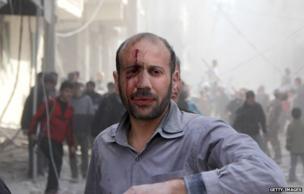
Barrel bomb victimImage copyrightGetty Images

A UN commission of inquiry, investigating alleged human rights violations since March 2011, has evidence that those on both sides of the conflict have committed war crimes - including murder, torture, rape and enforced disappearances. Government and rebel forces have also been accused by investigators of using civilian suffering - such as blocking access to food, water and health services - as a method of war.

In February 2014, a UN Security Council resolution demanded all parties end the "indiscriminate employment of weapons in populated areas". Since then, activists say, more than 6,000 civilians have been killed by barrel bombs dropped by government aircraft on rebel-held areas. The UN says in some instances, civilian gatherings have been deliberately targeted, constituting massacres.

Islamic State has also been accused by the UN of waging a campaign of terror in northern and eastern Syria. It has inflicted severe punishments on those who transgress or refuse to accept its rule, including hundreds of public executions and amputations. Its fighters have also carried out mass killings of rival armed groups, members of the security forces and religious minorities, and beheaded hostages, including several Westerners.

We're just living on the edge of life. We're always nervous, we're always afraid

Mother-of-nine Mariam Akash, whose husband was killed by a sniper
line break

4. Chemical weapons

Syrians in masksImage copyrightGetty Images

Hundreds of people were killed in August 2013 after rockets filled with the nerve agent sarin were fired at several agricultural districts around Damascus. Western powers, outraged by the attack, said it could only have been carried out by Syria's government. The regime and its ally Russia blamed rebels.

Facing the prospect of US military intervention, President Assad agreed to the complete removal or destruction of Syria's chemical weapons arsenal as part of a joint mission led by the UN and the Organisation for the Prohibition of Chemical Weapons (OPCW). The destruction of chemical agents and munitions was completed a year later. 

Despite the operation, the OPCW has since documented the use of toxic chemicals, such as chlorine and ammonia, by the government in attacks on rebel-held northern villages between April and July 2014 that resulted in the deaths of at least 13 people. 

Islamic State has also been accused of using homemade chemical weapons, possibly including the blistering agent sulphur mustard, against Kurdish forces and civilians in northern Syria.
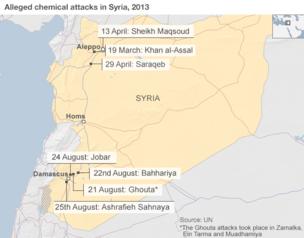
Map showing alleged chemical weapons attacks in Syria in 2013
line break

5. Humanitarian crisis

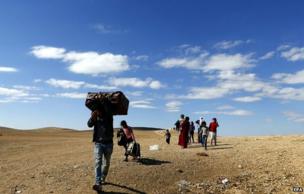
Syrian refugeesImage copyrightEPA

More than four million people have fled Syria since the start of the conflict, most of them women and children. It is one of the largest refugee exoduses in recent history. Neighbouring countries have borne the brunt of the refugee crisis, with Lebanon, Jordan and Turkey struggling to accommodate the flood of new arrivals. The exodus accelerated dramatically in 2013, as conditions in Syria deteriorated. 

A further 7.6 million Syrians have been internally displaced within the country, bringing the total number forced to flee their homes to more than 11 million - half the country's pre-crisis population. Overall, an estimated 12.2 million are in need of humanitarian assistance inside Syria, including 5.6 million children, the UN says.

In December 2014, the UN launched an appeal for $8.4bn (£5.6bn) to provide help to 18 million Syrians, after only securing about half the funding it asked for in 2014. By a year later, it was less than half funded.

report published by the UN in March 2015 estimated the total economic loss since the start of the conflict was $202bn and that four in every five Syrians were now living in poverty - 30% of them in abject poverty. Syria's education, health and social welfare systems are also in a state of collapse.

Syrian refugees in the region 
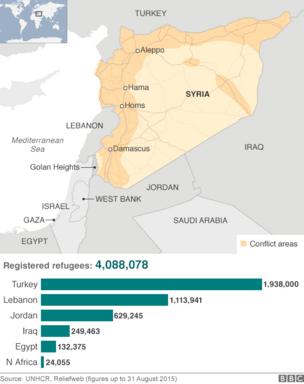
Map: Refugee numbers in Syria's neighbouring countries
line break

6. Rebels and the rise of the jihadists

Nusra Front fighterImage copyrightGetty Images

The armed rebellion has evolved significantly since its inception. Secular moderates are now outnumbered by Islamists and jihadists, whose brutal tactics have caused widespread concern and triggered rebel infighting.

Capitalising on the chaos in the region, Islamic State - the extremist group that grew out of al-Qaeda in Iraq - has taken control of huge swathes of territory across northern and eastern Syria, as well as neighbouring Iraq. Its many foreign fighters in Syria are now involved in a "war within a war", battling rebels and jihadists from the al-Qaeda-affiliated Nusra Front, who object to their tactics, as well as Kurdish and government forces. 

In September 2014, a US-led coalition launched air strikes inside Syria in an effort to "degrade and ultimately destroy" IS, helping the Kurds repel a major assault on the northern town of Kobane. But the coalition has avoided attacks that might benefit Mr Assad's forces or intervening in battles between them and the rebels.

In the political arena, opposition groups are also deeply divided, with rival alliances battling for supremacy. The most prominent is the moderate National Coalition for Syrian Revolutionary and Opposition Forces, backed by several Western and Gulf Arab states. However, the coalition has little influence on the ground in Syria and its primacy is rejected by other groups, leaving the country without a convincing alternative to the Assad government.

US-led coalition air strikes in Syria and Iraq
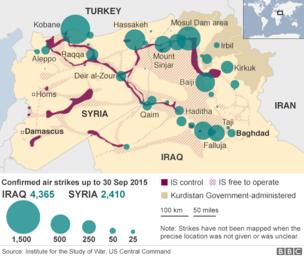
Map showing air strikes against targets in Iraq and Syria
line break

7. Peace efforts

Peace talks on SyriaImage copyrightGetty Images

With neither side able to inflict a decisive defeat on the other, the international community long ago concluded that only a political solution could end the conflict in Syria. However, a number of attempts by the Arab League and the UN to broker ceasefires and start dialogue have failed.

In January 2014, the US, Russia and UN convened a conference in Switzerland to implement the 2012 Geneva Communique, an internationally backed agreement that called for the establishment of a transitional governing body in Syria formed on the basis of mutual consent.

The talks, which became known as Geneva II, broke down in February after only two rounds. The then-UN special envoy Lakhdar Brahimi blamed the Syrian government's refusal to discuss opposition demands and its insistence on a focus on fighting "terrorists" - a term Damascus uses to describe rebel groups. 

UN Secretary General Ban Ki-moon says the organisation's long-term strategic objective remains a political solution based on the Geneva Communique. The UN special envoy Staffan de Mistura has also proposed establishing a series of "freeze zones", where local ceasefires would be negotiated to allow aid deliveries in besieged areas. But his attempt to broker a truce in Aleppo in March 2015 was rejected by rebels in the city, who feared the government would use it to redeploy its forces elsewhere and that IS militants would simply ignore it.

line break

8. Proxy war

Rebel fighterImage copyrightGetty Images

What began as another Arab Spring uprising against an autocratic ruler has mushroomed into a brutal proxy war that has drawn in regional and world powers.

Iran and Russia have propped up the Alawite-led government of President Assad and gradually increased their support. 

Tehran is believed to be spending billions of dollars a year to bolster Mr Assad, providing military advisers and subsidised weapons, as well as lines of credit and oil transfers. In September 2015, Russia launched an air campaign against Mr Assad's opponents. Moscow said it was targeting only "all terrorists", above all members of Islamic State, but many of the strikes hit Western-backed rebels and civilians.

The Syrian government has also enjoyed the support of Lebanon's Shia Islamist Hezbollah movement, whose fighters have provided important battlefield support since 2013.

The Sunni-dominated opposition has, meanwhile, attracted varying degrees of support from its main backers - Turkey, Saudi Arabia, Qatar and other Arab states along with the US, UK and France. However, the rise of hardline Islamist rebels and the arrival of jihadists from across the world have led to a marked cooling of Western backing. 

US-led coalition aircraft provide significant support to Kurdish militia fighters seeking to defend three autonomous enclaves in the country's north from attacks by IS. But a programme to train and arm 5,000 Syrian rebels to take the fight to IS on the ground has suffered embarrassing setbacks.

The disappointment caused by the West's inaction created a fertile recruiting ground for extremists, who told those who had lost their loved ones that they were their only hope


Top PS4 exclusive games slated for release in 2016

Sony PlayStation 4 loyalists did not have much to enjoy in 2015 as the number of high-profile game titles released -- exclusive to the console -- were comparatively less. There were multiple games that were seeded to Xbox One and PS4 consoles this year, but hardcore PS4 gamers expected many more exclusive titles, which were not released.

However, 2016 promises to be a feast for PS4 gamers as far as exclusive titles are concerned. IBTimesUK has compiled a list of prominent PS4-exclusive titles that are on track to be released in 2016. The list is as follows:

  • Uncharted 4: A thief's end

    Uncharted 4 is slated for release on 18 March 2016. The game is currently available on pre-orders. Naughty Dog is the title's developer.

    Game info: The game is set three years after Uncharted 3: Drake's Deception. In the newest iteration, Nathan Drake is presumed to have quit rapid fortune hunting. However, enter Sam (Drake's brother) who offers him a life of adventure again. This takes gamers on a journey around the world through jungle isles, remote cities and snow-capped mountains.

    Watch trailer video below:

  • The Last Guardian

    Although the exact release date is yet to be confirmed at this point in time, it is rumoured that the game could be released exclusively to PS4 consoles in 2016.

    Game info: A major highlight of the game is the chemistry between a young boy and hybrid creature, when the boy tries to escape from a large castle. Gamers will have to bring out their best in-game survival skills as the boy-hybrid creature combination would need to survive greater challenges and obstacles.

  • Street Fighter 5:

    Release date: 16 February 2016. The game is exclusive to Sony's PS4 and to PC platforms across the world.

    Developers: Sony and Capcom

    Key game info: Street Fighter 5 promises next-gen visuals with its Unreal Engine 4 technology. Gamers can challenge other gamers online as well.

  • No Man's Sky:

    Release Date: June 2016.

    Developer: Hello Games

    Key Game Info: No Man's Sky requires gamers to explore and survive in a new galaxy altogether. Players can fly seamlessly from one planet to another, and even explore stars on their way. However, each planet poses its own set of dangers and adventure.
    Watch trailer video below:

Sunday, January 10, 2016

Top 7 Fun Facts about Jurassic World

On June 12, the Jurassic Park franchise returns to theaters for a fourth time with Jurassic World, a new feature film starring Chris Pratt, Bryce Dallas Howard, Vincent D’Onofrio, Ty Simpkins, Nick Robinson, and Irrfan Khan.

Jurassic World is not a reboot of the franchise and the film’s director, Colin Trevorrow, considers it to be a direct sequel to the original movie. Twenty two years have passed since the events of Jurassic Park, and the latest film in the franchise will follow all-new characters, alongside new dinosaurs and perhaps a familiar face or two.

ComingSoon.net has already profiled Jurassic World’s characters and dinosaurs, but now it’s time to look at some of the fun facts and trivia surrounding the film itself.

1.There’s Only One Actor Returning From Jurassic Park

In an interesting bit of Jurassic World trivia, B.D. Wong is the only actor from the original film reprising his role.

If you’re holding out for cameo appearances by Sam Neill, Laura Dern and/or Jeff Goldblum, then you’re going to be disappointed. Trevorrow has publicly said that he didn’t want to shoehorn their characters into the movie and that their return would have been contrived if it was simply forced to happen within the script.

But there is at least one human character coming back: Dr. Henry Wu, as played by B.D. Wong (pictured above). Dr. Wu appeared in the first Jurassic Park movie as the head of the scientific team that brought the dinosaurs back to life. Presumably Dr. Wu is now employed by Masrani Global Corporation, the new owners of Jurassic World.

2.The Legacy of John Hammond Survives

Find out what part the legacy of Richard Attenborough plays in the new film in our Jurassic World trivia guide!

The late Richard Attenborough expressed his desire to return for the fourth Jurassic Park movie, but he passed away during the film’s long development. Attenborough’s character from the first two films, John Hammond, will also be deceased in Jurassic World, but his vision lives on thanks to the fully-functioning dinosaur theme park that exists in the movie.

As a tribute to Attenborough, a statue of John Hammond (see photo) will be seen in Jurassic World and he will be identified as the founder of both Jurassic Park and InGen, the company that brought the dinosaurs back from extinction.

3.Jurassic World Spent Over a Decade in Development Hell

Find out all sorts of intriguing facts in our Jurassic World Trivia guide.

A fourth Jurassic Park film was mentioned as far back as 2001, during the buildup for Jurassic Park III. Executive producer (and the director of the first two Jurassic Park films) Steven Spielberg confirmed that a fourth movie was in the works during a 2002 interview.

But in the intervening years, Spielberg wasn’t satisfied by any of the scripts that were created for the sequel. The death of Jurassic Park novelist Michael Crichton in 2008 was also a setback for the project, according to producer Kathleen Kennedy.

Spielberg announced that the Jurassic Park sequel was back on in 2011 at Comic-Con International, and Trevorrow was signed to direct it in 2013. Jurassic World was pushed back once more from its original June 2014 release date, but it will finally hit theaters in a few weeks.

4.Steven Spielberg Wouldn’t Let Jurassic World be Rushed Out

Our Jurassic World trivia guide covers some cool facts about producer Steven Spielberg.

Spielberg was personally responsible for the final delay of Jurassic World, because he wanted the final film to be good. A script was written in three weeks and Universal Pictures was reportedly pushing for a fast turnaround on the film with production to start in June 2013. Fortunately, Spielberg had the clout to shut down production until the script met his approval. Jurassic World finally began filming in April 2014.

5.Casting a Wide Net

Find out what has been happening behind the scenes in our Jurassic World trivia guide!

Several actors were considered to play Owen Grady, the new lead character of Jurassic World. Garrett Hedlund, Jason Statham, John Krasinski, Jason Sudeikis, Josh Brolin, Henry Cavill, Armie Hammer, and Glenn Howerton were reportedly among the top contenders before Chris Pratt was cast in the role.

Keira Knightley and Kristen Stewart were also rumored to be up for the role of Claire Dearing, but Bryce Dallas Howard was ultimately chosen for the part.

6.The Law & Order and Comic Book Movie Connection

Meet some of the new characters in our Jurassic World trivia guide.

Through the first four films of the Jurassic Park franchise, several Law & Order veterans have been featured, including Jeff Goldblum in the first two films, and Trevor Morgan in Jurassic Park III. Vincent D’Onofrio and B.D. Wong also have a history with that TV franchise, with D’Onofrio headlining Law & Order: Criminal Intent for several seasons.

Oddly enough, Jurassic World also boasts several actors who have appeared in Marvel Comics-inspired films, including Chris Pratt (Guardians of the Galaxy), Bryce Dallas Howard (Spider-Man 3), Ty Simpkins (Iron Man 3), Irrfan Khan (The Amazing Spider Man), and Omar Sy (X-Men: Days of Future Past).

D’Onofrio also has a Marvel credit as Wilson Fisk in the Daredevil series on Netflix.

7.Trevorrow Lost a Battle for Screenplay Credit

Welcome to ComingSoon.net's guide to Jurassic World trivia!

By all accounts, Trevorrow and his writing partner, Derek Connolly, did a very significant amount of rewriting on the Jurassic World script. Universal Pictures put forth Trevorrow and Connolly for the sole screenplay credit when the script was submitted to the Writers Guild of America for arbitration.

However, the WGA decided that an earlier draft of the script by Rick Jaffa and Amanda Silver meant that the husband-and-wife writing duo also deserved a credit on the Jurassic World screenplay. A second arbitration hearing led to Jaffa and Silver also getting the coveted “story by” credit.

After the story broke, Trevorrow told Deadline that “I have spoken with Rick and Amanda several times over the past few days. Though we may not agree on the specifics of this ruling, we share a disdain for the arbitration process and the ugliness it often breeds. Our conversations ended in a spirit I’d like to think the Guild would support — that credit could be equally shared. Jurassic World is a special film, and I’d rather acknowledge these writers as co-designers of this adventure than bitter enemies who must be avoided at parties.”

7 Tricks to Improve Your Memory

1. Eat Right

The foods you eat – and don't eat – play a crucial role in your memory. Fresh vegetables are essential, as are healthy fats and avoiding sugar and grain carbohydrates. You can find detailed information about nine foods for brainpower here

For instance, curry, celery, broccoli, cauliflower, and walnuts contain antioxidants and other compounds that protect your brain health and may even stimulate the production of new brain cells. 

Increasing your animal-based omega-3fat intake and reducing consumption of damaged omega-6 fats (think processed vegetable oils) in order to balance your omega-3 to omega-6 ratio, is also important. I prefer krill oil to fish oil, as krill oil also contains astaxanthin, which not only protects the omega-3 fats from oxidation but also appears to be particularly beneficial for brain health. 

Coconut oil is another healthful fat for brain function. According to research by Dr. Mary Newport, just over two tablespoons of coconut oil (about 35 ml or 7 level teaspoons) would supply you with the equivalent of 20 grams of medium-chain triglycerides (MCT), which is indicated as either a preventative measure against degenerative neurological diseases, or as a treatment for an already established case. 

2. Exercise

Exercise encourages your brain to work at optimum capacity by stimulating nerve cells to multiply, strengthening their interconnections and protecting them from damage. 

During exercise nerve cells release proteins known as neurotrophic factors. One in particular, called brain-derived neurotrophic factor (BDNF), triggers numerous other chemicals that promote neural health, and directly benefits cognitive functions, including learning.

A 2010 study on primates published in Neuroscience also revealed that regular exercise not only improved blood flow to the brain, but also helped the monkeys learn new tasks twice as quickly as non-exercising monkeys. 

This is a benefit the researchers believe would hold true for people as well.1 In a separate one year-long study, individuals who engaged in exercise were actually growing and expanding the brain's memory center one to two percent per year, where typically that center would have continued to decline in size. 

To get the most out of your workouts, I recommend a comprehensive program that includes high-intensity interval exercise, strength training, stretching, and core work, along with regular intermittent movement.

3. Stop Multitasking

Used for decades to describe the parallel processing abilities of computers, multitasking is now shorthand for the human attempt to do simultaneously as many things as possible, as quickly as possible. Ultimately, multitasking may actually slow you down, make you prone to errors as well as make you forgetful. 

Research shows you actually need about eight seconds to commit a piece of information to your memory, so if you're talking on your phone and carrying in groceries when you put down your car keys, you're unlikely to remember where you left them.

The opposite of multitasking would be mindfulness, which helps you achieve undistracted focus. Students who took a mindfulness class improved reading comprehension test scores and working memory capacity, as well as experienced fewer distracting thoughts.2

If you find yourself trying to complete five tasks at once, stop yourself and focus your attention back to the task at hand. If distracting thoughts enter your head, remind yourself that these are only "projections," not reality, and allow them to pass by without stressing you out. You can then end your day with a 10- or 15-minute meditation session to help stop your mind from wandering and relax into a restful sleep.

4. Get a Good Night's Sleep

Research from Harvard indicates that people are 33 percent more likely to infer connections among distantly related ideas after sleeping,3 but few realize that their performance has actually improved. Sleep is also known to enhance your memories and help you "practice" and improve your performance of challenging skills. In fact, a single night of sleeping only four to six hours can impact your ability to think clearly the next day. 

The process of brain growth, or neuroplasticity, is believed to underlie your brain's capacity to control behavior, including learning and memory. Plasticity occurs when neurons are stimulated by events, or information, from the environment. However, sleep and sleep loss modify the expression of several genes and gene products that may be important for synaptic plasticity. 

Furthermore, certain forms of long-term potentiation, a neural process associated with the laying down of learning and memory, can be elicited in sleep, suggesting synaptic connections are strengthened while you slumber.

As you might suspect, this holds true for infants too, and research shows that naps can give a boost to babies' brainpower. Specifically, infants who slept in between learning and testing sessions had a better ability to recognize patterns in new information, which signals an important change in memory that plays an essential role in cognitive development.4 There's reason to believe this holds true for adults, too, as even among adults, a mid-day nap was found to dramatically boost and restore brainpower.5 You can find 33 tips to help you get the shut-eye you need here.

5. Play Brain Games

If you don't sufficiently challenge your brain with new, surprising information, it eventually begins to deteriorate. What research into brain plasticity shows us, however, is that by providing your brain with appropriate stimulus, you can counteract this degeneration. 

One way to challenge your brain is via 'brain games,' which you can play online via Web sites like Lumosity.com. Dr. Michael Merzenich, professor emeritus at the University of California, who I interviewed two years ago, has pioneered research in brain plasticity (also called neuroplasticity) for more than 30 years, has also developed a computer-based brain-training program that can help you sharpen a range of skills, from reading and comprehension to improved memorization and more. 

The program is called Brain HQ, and the website has many different exercises designed to improve brain function and it also allows you to track and monitor your progress over time. While there are many similar sites on the Web, Brain HQ is one of the oldest and most widely used. 

If you decide to try brain games, ideally it would be wise to invest at least 20 minutes a day, but no more than five to seven minutes is to be spent on a specific task. When you spend longer amounts of time on a task, the benefits weaken. According to Dr. Merzenich, the primary benefits occur in the first five or six minutes of the task. The only downside to brain games is that it may become just another "task" you need to fit into an already busy day. If you don't enjoy brain games, you can also try learning a new skill or hobby (see below).

6. Master a New Skill

Engaging in "purposeful and meaningful activities" stimulates your neurological system, counters the effects of stress-related diseases, reduces the risk of dementia and enhances health and well-being.6 A key factor necessary for improving your brain function or reversing functional decline is the seriousness of purpose with which you engage in a task. In other words, the task must be important to you, or somehow meaningful or interesting — it must hold your attention.

For instance, one study revealed that craft activities such as quilting and knitting were associated with decreased odds of having mild cognitive impairment.7 Another study, published earlier this year, found that taking part in "cognitively demanding" activities like learning to quilt or take digital photography enhanced memory function in older adults.8 The key is to find an activity that is mentally stimulating for you. Ideally this should be something that requires your undivided attention and gives you great satisfaction… it should be an activity that you look forward to doing, such as playing a musical instrument, gardening, building model ships, crafting or many others.

7. Try Mnemonic Devices

Mnemonic devices are memory tools to help you remember words, information or concepts. They help you to organize information into an easier-to-remember format. Try:

  • Acronyms (such as PUG for "pick up grapes")
  • Visualizations (such as imagining a tooth to remember your dentist's appointment)
  • Rhymes (if you need to remember a name, for instance, think "Shirley's hair is curly)
  • Chunking, which is breaking up information into smaller "chunks" (such as organizing numbers into the format of a phone number)